


Rigid Couplings Consistently Deliver Precise Alignment Screw Conveyors Require
In grain harvesting and production systems, screw conveyors require precise shaft alignment to ensure optimal torque transmission, maximized system efficiency, and maintain consistent material flow throughout the process.
 Screw conveyors are widely used in the grain industry for handling, transporting, and processing a large volume of material efficiently through the production process. Widely utilized in grain processing for their flexibility, screw conveyors feature a fully enclosed design that reduces dust emissions and cross-contamination, while enabling consistent, metered transport of grain from initial intake through to final packaging. As these systems depend on continuous shaft rotation, shaft connections are critical for performance and reliability.
Climax Rigid Couplings are the true workhorse of the coupling family. Rigid couplings provide a precise shaft alignment and torque transmission in applications where no relative movement between shafts is required. A simple, solid construction makes them ideal for high-torque, low-speed systems. Delivering a maintenance-free, robust solution for connecting drive shafts to screw shafts, rigid couplings are ideal for demanding grain-handling environments. (more…)
Keyless Rigid Moment Couplings Ensure Connection in Agriculture Conveying Equipment
Climax C600-Series Keyless Rigid Moment Couplings provide a superior solution for hydraulic motors and gearboxes over traditional misalignment couplings in agriculture applications.
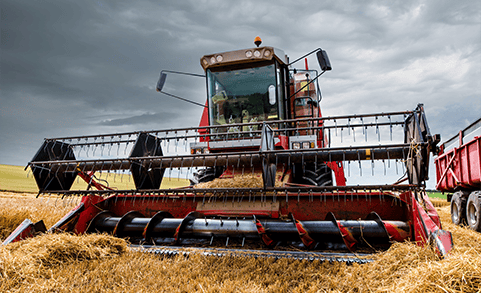
Combine Harvesters Incorporate Conveyor Belts
When it’s time to harvest mature crop growth, combine harvesters are the most commonly used harvesting equipment by farmers. With an expected annual growth rate of 8.2% through 2030, combine harvesters are equipped with multiple conveyor belts that facilitate the reaping, threshing, and winnowing required during the harvesting process. Traditional methods for mounting hydraulic motors and gearboxes in conveyor applications often incorporate misalignment couplings that require frequent servicing. This potential failure can lead to downtime, negatively impacting production and profitability.